Loading Docks, Ceiling Heights, and Power Requirements: Understanding Industrial Property Specs
Understanding industrial property specs before signing a lease can save you from costly mistakes—or worse, discovering your new facility can’t support your operations. Three specifications matter most: loading dock configuration, ceiling clear height, and electrical power capacity. Get any of these wrong, and you’ll face expensive modifications, operational bottlenecks, or an early lease termination.
This guide breaks down each specification in detail, explains what you need based on your operation type, and gives you a practical checklist for evaluating any industrial property.
Key Takeaways
- Loading docks: Dock-high doors (48-52″ height) for semi-trailers; grade-level doors for vans and forklifts. Plan for 120’+ truck court depth.
- Clear height: Modern distribution needs 32-40′ clear; manufacturing typically needs 18-30′; each additional foot adds 7-10% storage capacity.
- Power: Light industrial needs 200-400 amp; warehousing needs 400-600 amp; manufacturing needs 800-2000+ amp, all three-phase.
- Dock ratios: Distribution centers need 1 dock per 5,000-10,000 SF; manufacturing needs 1 per 15,000-20,000 SF.
- Clear height is nearly impossible to change post-construction—prioritize this spec when evaluating properties.
Loading Docks and Access Points
Your loading configuration determines how efficiently you can move product in and out of your facility. The wrong setup creates bottlenecks that compound daily, while the right configuration keeps operations flowing smoothly.
Types of Loading Configurations
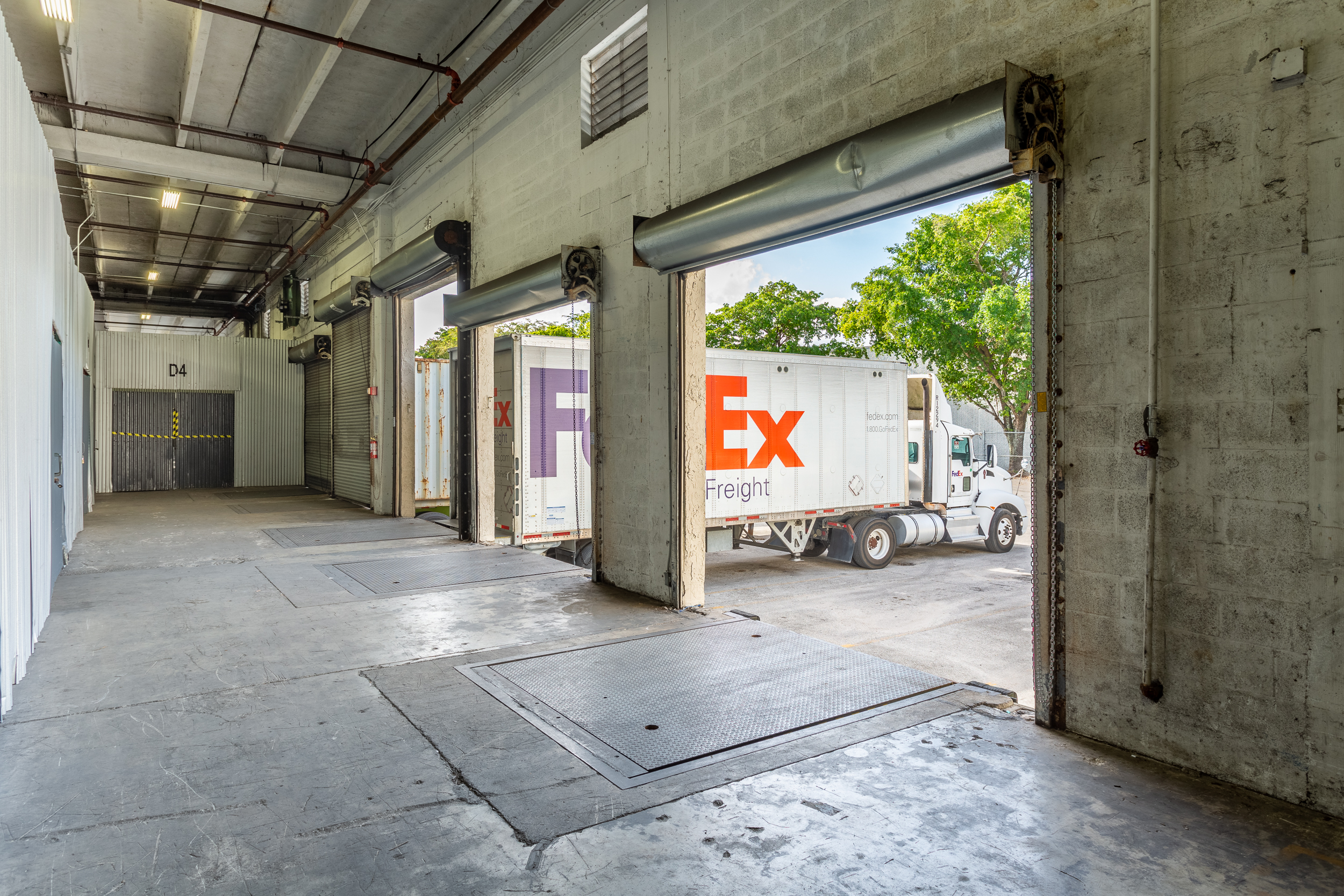
Dock-High Doors
- Description: Elevated doors positioned 48-52 inches above ground level
- Ideal for: Businesses receiving deliveries from semi-trailers
- Key measurements: Standard door dimensions are 8’W × 10’H or 9’W × 10’H
Drive-In or Grade-Level Doors
- Description: Ground-level doors allowing direct vehicle access
- Ideal for: Businesses using vans, pickup trucks, or forklifts for loading/unloading
- Key measurements: Typically 12’W × 14’H or 14’W × 16’H
Most operations benefit from a mix of both door types. If you’re evaluating a property with only one type, consider whether your shipping and receiving patterns can adapt—or whether you’ll need to add doors post-lease.
Loading Dock Equipment
| Equipment | Purpose | Types/Specs |
|---|---|---|
| Dock Levelers | Bridge the gap between truck and building | Hydraulic, mechanical, air-powered; 25,000-50,000 lb capacity |
| Dock Seals | Create weather-tight barrier around trucks | Compression seals (foam pads) or shelters (canopy-style) |
| Dock Bumpers | Protect building and vehicle during docking | Molded rubber, laminated rubber, steel-faced; 7’4″ apart standard |
Truck Court Considerations
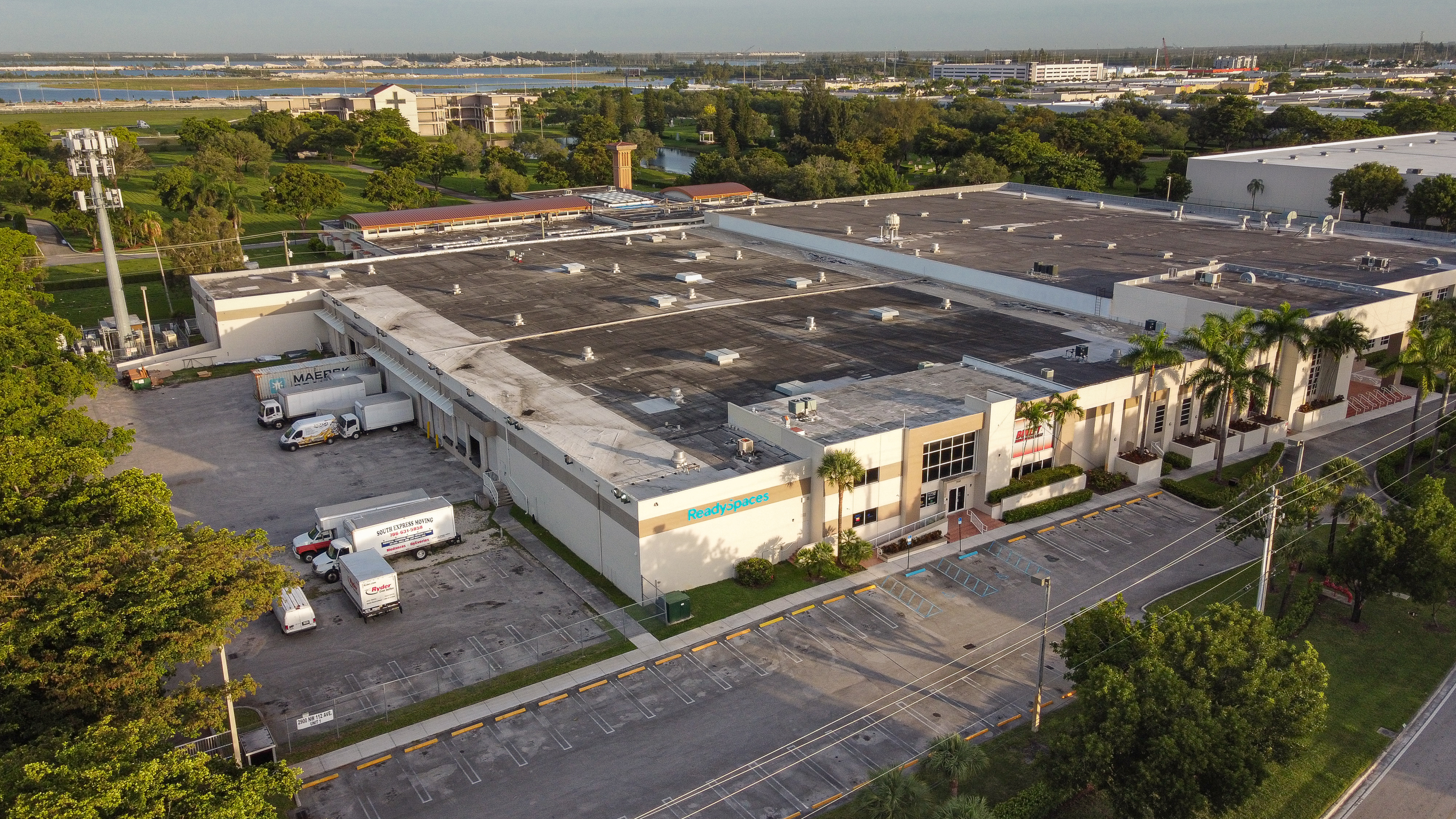
The truck court—the paved area where trucks maneuver and back into docks—is often overlooked until it becomes a problem. Inadequate truck courts create traffic jams, damage vehicles, and slow your entire operation.
Apron Depth Requirements
- Definition: Distance from the building to the opposite edge of the truck court
- 120′ minimum: Standard trailers with adequate maneuvering space
- 130’+: Extended trailers or busy operations with multiple trucks
- 170’+: Operations requiring trailer storage in the court
Turning Radius
- Standard 53′ trailer: Approximately 105′ outside turning diameter
- City delivery trucks: 45-65′ turning diameter
- Key consideration: Entry points from public streets—tight turns from main roads compound maneuvering challenges
Loading Position Ratios
How many dock doors do you need? Industry standards vary by operation type:
| Operation Type | Dock Ratio |
|---|---|
| Distribution centers | 1 dock per 5,000-10,000 SF |
| Light industrial / flex | 1 dock per 8,000-12,000 SF |
| Manufacturing | 1 dock per 15,000-20,000 SF |
Higher ratios needed for: Cross-docking operations, high inventory turnover, just-in-time manufacturing, and operations with multiple daily deliveries.
Ceiling Heights
Clear height is arguably the most important industrial property spec because it’s the hardest to change. You can add dock doors, upgrade power, and modify layouts—but raising the roof is rarely feasible. For guidance on how ceiling height affects different operation sizes, see our guide to manufacturing space requirements by growth stage.
Understanding Clear Height Measurements
- Clear height: Usable height from floor to lowest overhead obstruction
- Obstructions include: Joists, trusses, sprinklers, lights, HVAC ducts
- Building height: Typically 2-4 feet greater than clear height
Why it matters: Each additional foot of clear height adds 7-10% storage capacity. A 32′ clear building holds significantly more inventory than a 24′ building with the same footprint—without any increase in your lease cost per square foot.
Pro Tip
When touring properties, measure clear height at multiple points throughout the building. HVAC units, fire suppression systems, and structural elements can reduce usable height in specific zones. The lowest point determines what racking you can actually install.
Clear Height Standards by Use Type
| Use Type | Modern Standard | Legacy Buildings |
|---|---|---|
| Distribution / E-commerce | 32-40+ feet | 24-28 feet |
| Heavy Manufacturing | 24-30+ feet | 18-24 feet |
| Light Manufacturing | 18-24 feet | 14-18 feet |
| Flex / Mixed-Use | 16-24 feet | 12-16 feet |
Clear Height Premium
Taller buildings command higher rents—but often deliver better value per cubic foot of usable space.
Market value impact:
- Each additional foot of clear height typically adds $0.15-$0.30/SF to annual rent
- Premium buildings (36’+ clear) command 20-30% higher rates than older buildings (24′ clear)
Operating cost effects:
- Heating/cooling: Higher spaces cost more to condition
- Lighting: More fixtures and power required for taller spaces
- Sprinkler systems: Higher clear heights require more extensive coverage
Specialized Ceiling Features
Crane systems: If your operation requires overhead cranes, you’ll need to specify hook height, capacity (tonnage), and span distance. Crane-ready buildings require reinforced structures and often have reduced clear height below the crane rail.
Mezzanines: Buildings with 24’+ clear height can often accommodate mezzanine installations, adding usable square footage within your existing footprint. Verify the building structure can support the additional load before planning a mezzanine.
Power Requirements
Electrical capacity determines what equipment you can run—and whether you can run it all simultaneously. Undersized power service is one of the most common surprises tenants discover after signing a lease, and upgrades can take 3-9 months and cost $50,000-$500,000+.
Electrical System Basics
Service types:
- Single-phase power: 120/240V, suitable for basic lighting, HVAC, office equipment
- Three-phase power: 208V, 240V, or 480V, required for most industrial equipment
- High-voltage service: 600V+, specialized manufacturing applications
Capacity measurements:
- Amperage: Total current capacity (e.g., 400 amp, 800 amp, 1200 amp service)
- Voltage: Electrical pressure/potential
- Phase: Method of power distribution (single or three-phase)
Power Requirements by Use Type
| Use Type | Service | Density | Supports |
|---|---|---|---|
| Light Industrial / Flex | 200-400 amp, 3-phase | 5-10 W/SF | Small equipment, standard lighting, basic HVAC |
| General Warehousing | 400-600 amp, 3-phase | 10-15 W/SF | Conveyor systems, charging stations, lighting |
| Manufacturing | 800-2000+ amp, 3-phase | 20-50+ W/SF | Heavy equipment, production machinery |
| Data Center / High-Tech | 2000+ amp, redundant | 100-200+ W/SF | Servers, intensive cooling systems |
Assessing Existing Power Infrastructure
Service verification:
- Main disconnect rating: Shows total amperage capacity
- Transformer size: Indicates maximum available power
- Panel schedule: Lists circuits and capacities
- Utility records: Confirm actual service specifications
Power distribution:
- Bus duct: Overhead power distribution system
- Panel locations: Proximity to planned equipment placement
- Sub-panels: Capacity and locations throughout facility
Important
Power upgrades can take 3-9 months and cost $50,000-$500,000+ depending on scope. Before signing a lease, verify the utility has capacity at the street and get a timeline and cost estimate for any required upgrades. Build this into your lease negotiations.
Special Power Considerations
Backup power:
- Generator compatibility: Space and connections for emergency power
- Transfer switch location: Required for generator integration
- Critical load assessment: Determining which systems need backup
Sustainable energy options:
- Solar readiness: Roof structural capacity and orientation
- EV charging infrastructure: Capacity for vehicle charging stations
- Energy storage: Space and connections for battery systems
Property Evaluation Checklist
Before signing any industrial lease, verify these specifications match your operational requirements. For more on lease structures and what you’ll actually pay, see our guide to warehouse lease types explained.
Loading dock verification:
- Door dimensions and types (dock-high vs. grade-level)
- Dock height and leveler condition
- Truck court apron depth (measure it yourself)
- Traffic patterns and entry/exit points
Clear height confirmation:
- Measure at multiple points throughout the building
- Note all obstructions (HVAC, sprinklers, lighting, structural)
- Identify lowest point and plan racking accordingly
Power verification:
- Check transformer and main disconnect
- Review panel schedule for available capacity
- Verify voltage and phase match your equipment needs
- Confirm utility capacity for future upgrades
Common Pitfalls and Solutions
Loading Area Issues
Insufficient truck court depth: Signs include difficult trailer positioning and traffic congestion. Solutions: Staggered shipping/receiving schedules, traffic management systems, smaller delivery vehicles where possible.
Inadequate number of docks: Signs include loading backups and extended wait times. Solutions: Additional dock positions (if building allows), appointment scheduling, off-peak shipping/receiving hours.
Ceiling Height Limitations
Insufficient stacking height: Signs include excessive floor space used for storage and inefficient layout. Solutions: Narrow aisle racking systems, mezzanine installation where height permits, more frequent inventory turnover.
Obstructions below listed clear height: Signs include inability to fully utilize vertical space. Solutions: Custom racking design around obstructions, relocation of HVAC or utilities where possible, strategic layout planning.
Power Supply Challenges
Undersized electrical service: Signs include circuit trips and inability to run all equipment simultaneously. Solutions: Load management systems, staggered equipment operation, service upgrade (if feasible and timeline allows).
Incorrect voltage or phase: Signs include equipment that cannot operate properly. Solutions: Phase converters (limited applications), transformers for voltage adjustment, utility service upgrade.
Real-World Examples
Distribution Company Expansion
A growing distribution company needed to move from a 15,000 SF facility with 24′ clear height to accommodate increasing inventory.
Requirements: 30’+ clear height for taller racking, multiple dock doors for concurrent loading/unloading, adequate power for conveyor systems and charging stations.
Solution: 40,000 SF facility with 32′ clear height, 8 dock doors with hydraulic levelers, 800 amp 277/480V service.
Result: 175% increase in storage capacity despite only 167% increase in square footage—the additional clear height delivered more value than the square footage alone.
Manufacturing Facility Relocation
A precision manufacturing company needed to relocate from an outdated facility that couldn’t support their specialized equipment.
Requirements: 1200 amp 480V three-phase power, 24’+ clear height for equipment, drive-in doors for machinery movement, heavy floor load capacity.
Solution: Former distribution center converted to manufacturing with power upgraded from 600 amp to 1500 amp, two new 14’×16′ drive-in doors added, floor reinforced in key production areas.
Result: 30% increase in production capacity in the new facility.
Frequently Asked Questions
What is clear height in a warehouse?
Clear height is the usable vertical space from the floor to the lowest overhead obstruction—not the roof or ceiling itself. Obstructions include joists, trusses, sprinkler heads, lighting fixtures, and HVAC ducts. The clear height determines how tall your racking can be and directly impacts your storage capacity.
How many loading docks do I need for my warehouse?
The standard ratio varies by operation type. Distribution centers typically need 1 dock position per 5,000-10,000 square feet due to high shipping volume. Manufacturing operations need fewer docks—roughly 1 per 15,000-20,000 square feet. Cross-docking operations, just-in-time manufacturing, and high-turnover businesses need ratios at the higher end of these ranges.
What’s the difference between dock-high and grade-level doors?
Dock-high doors are elevated 48-52 inches to align with semi-trailer beds, allowing forklifts to drive directly into trailers. Grade-level (drive-in) doors sit at ground level, allowing vehicles like vans, pickup trucks, and forklifts to enter the building directly. Most operations benefit from having both types available.
How much power does a warehouse need?
Power requirements vary significantly by use. Light industrial and flex spaces typically need 200-400 amp three-phase service. General warehousing with conveyors and charging stations needs 400-600 amps. Manufacturing operations often require 800-2000+ amps depending on equipment. Always calculate your specific equipment requirements and add 20-30% for future growth.
How much does it cost to upgrade warehouse power?
Power upgrades can range from $50,000 for modest increases to $500,000+ for major service upgrades. Timeline is often 3-9 months depending on utility capacity and permitting. Before signing a lease, verify the utility has capacity at the street and get written estimates for any required upgrades. Factor these costs and timelines into your lease negotiations.
Conclusion
Loading docks, ceiling heights, and power requirements might seem like technical details, but they fundamentally determine whether an industrial property can support your business operations. Understanding these specs enables you to quickly eliminate unsuitable properties, accurately estimate improvement costs, negotiate leases with clear knowledge of a property’s actual value, and plan for efficient operations from day one.
Remember that clear height is nearly impossible to change after construction, while adding dock positions or upgrading power can be feasible with the right budget and timeline. Focus on finding a property where the fundamental specifications meet your needs, then consider modifications for less critical elements.
For more guidance on evaluating industrial properties, explore our Industrial 101 resource center.
Find Industrial Space That Fits Your Specs
Browse available properties with detailed specifications including clear heights, dock counts, and power capacity.
Search Available Properties