Atlanta Industrial & Warehouse Market Report | Q1 2026
Key Takeaways
- Atlanta’s industrial warehouse market posted 4.1–5.2 million SF of net absorption in Q1 2026 — the strongest quarter since 2022 and more than five times Q1 2025. The market is stabilizing, not softening.
- Overall vacancy sits at 8.3–8.7% depending on source, roughly stable year-over-year. Average asking rents rose 2.2% YoY to $9.93/SF NNN — above the national growth pace.
- I-85 North continues to dominate, with vacancy below 7% and 3.4M SF of absorption in Q1 alone. Airport/South Atlanta hit 10.6% vacancy but is turning positive after large 2025 move-outs.
- Small-bay and infill assets are outperforming big-box logistics space across every submarket. Construction has reaccelerated to a three-year high (14.3M SF), signaling renewed developer confidence. Browse Atlanta warehouse listings on WareCRE.
8.3%
Overall Vacancy
$9.93
Avg. Asking Rent (NNN/SF)
14.3M
SF Under Construction
4.1M+
SF Absorbed in Q1
Atlanta’s industrial market just posted its strongest quarter in nearly four years. After a period of rising vacancy as the post-pandemic construction wave delivered into normalizing demand, Q1 2026 marked an inflection point: absorption surged, deliveries slowed, and the Southeast’s largest distribution hub started tightening again.
For businesses looking for warehouse space in Atlanta, the data tells a nuanced story. The headline vacancy rate masks a sharp split between submarkets and building types — I-85 North is functionally tight while Airport/South Atlanta works through large-block vacancies. Small-bay and infill industrial space remains structurally undersupplied across the entire metro. Here’s what the numbers actually show, and what they mean for leasing, pricing, and site selection decisions in 2026.
Market Snapshot: Q1 2026
| Metric | Q1 2026 | Change (YoY) |
|---|---|---|
| Overall vacancy | 8.3–8.7% | +20–50 bps |
| 5-year average vacancy | 7.1% | – |
| Avg. asking rent (NNN) | $9.93/SF | +2.2% |
| Total industrial inventory | 803M SF | – |
| Q1 net absorption | 4.1–5.2M SF | +5x vs Q1 2025 |
| Under construction | 14.3M SF | 3-year high |
| Trailing-year investment sales | $5.9B | Above recent avg. |
The range in reported vacancy reflects different methodological approaches across brokerages. CBRE reports 7.5% direct vacancy; Cresa and Matthews report 8.3–8.4%; Savills reports 9.6% including sublease. Regardless of which number you use, the trajectory is what matters: absorption is accelerating, deliveries are slowing, and the market is moving toward equilibrium.
Rent Trends: Moderating, Not Declining
Average asking rents across metro Atlanta reached $9.93/SF NNN in Q1 2026, up 2.2% year-over-year — above the national growth pace of 2.1%. That’s a more measured pace than the sharp gains of 2021–2024, but still positive. Rents have climbed 65% over the past five years, and the market hasn’t posted a negative annual print.
The story, as always in Atlanta, depends on where you’re looking:
Premium corridors (I-85 North, GA-400): GA-400/North commands $14.75/SF — the highest in the metro — supported by limited supply, strong demographics, and sustained last-mile demand. I-85 North ranges from $10–12/SF for well-located Class A product.
Value submarkets (Airport/South, I-20 West): Rents in the $6.50–8.50/SF range, with more landlord flexibility on terms. The Airport/South Atlanta correction is creating the best value opportunities in the metro for tenants willing to look south of I-20.
Small-bay and multi-tenant: This segment continues to command a premium. Limited new supply in the sub-50,000 SF category means landlords have pricing power in infill locations, particularly in the I-85 corridor and West Atlanta industrial core.
For Tenants
If you need 20,000+ SF of big-box distribution space, you have more negotiating leverage now than at any point since 2020 — especially in Airport/South Atlanta and Homestead corridors. If you need under 10,000 SF in the I-85 corridor or West Atlanta, expect competition for quality space. Browse Atlanta warehouse listings on WareCRE to see what’s available now.
Construction Pipeline: Reaccelerating
Atlanta’s construction pipeline totals 14.3 million SF as of Q1 2026 — a three-year high and the most quarterly construction starts since 2022, according to Avison Young. This signals renewed developer confidence after a period of pullback.
But the delivery side tells a different story. Only 2.2 million SF was completed in Q1, well below the five-year quarterly average of 6.1 million SF. That gap between starts and deliveries means the near-term supply picture is actually easing even as the future pipeline grows.
Build-to-suit activity is a bright spot. Large occupiers with specific operational requirements are bypassing the spec market entirely, accounting for a growing share of new construction. This is healthy absorption — it adds to the inventory total without adding to vacancy.
The key question for 2027: will the reaccelerating pipeline overshoot demand again? Atlanta’s developers have been burned before — the 2022–2023 spec boom drove vacancy from 5% to 9% in less than two years. Lending conditions and pre-leasing requirements are more disciplined this cycle, but the pattern bears watching.
For Operators
If you own well-located small-bay product, you’re in a fundamentally different market than owners of new spec big-box. The data supports holding rate on quality small-bay product — there is virtually no new competitive supply in the sub-50K SF segment. If your vacancy is rising, it’s building-specific, not market-driven.
Submarket Breakdown
I-85 North (Gwinnett — Jackson County)
Atlanta’s golden corridor for distribution and the clear leader in Q1 2026 performance. I-85 North posted 3.4 million SF of net absorption — clearing the 1 million SF threshold in four of the past five quarters. Vacancy runs below 7%, the tightest in the metro. Asking rents range from $10–12/SF NNN for Class A product, with premium last-mile locations near Gwinnett commanding higher. Amazon, Home Depot, and Walmart all have massive operations here, and the corridor’s e-commerce infrastructure continues to attract mid-size occupiers.
Airport / South Atlanta (Clayton — Henry County)
The submarket going through the sharpest correction. Airport/South vacancy climbed to 10.6% in Q1 2026 — up 250 basis points year-over-year — driven by large-block move-outs, most notably DHL’s departure from its 1 million SF facility at Douglas Hills Logistics Center. But Q1 marked a turning point: the submarket posted 800,000 SF of positive absorption, its first significant positive quarter after a string of negative prints. Rates ($6.50–8.50/SF NNN) offer the best value in the metro, and proximity to Hartsfield-Jackson remains a structural advantage for air cargo and logistics operations.
I-20 West (Douglas — Fulton County)
The Fulton Industrial Boulevard corridor is quietly having its best run in years. I-20 West posted 600,000 SF of positive net absorption in Q1 2026 — its fourth consecutive quarter of occupancy gains and the submarket’s strongest quarterly total since Q3 2024. Rates ($7–8.50/SF NNN) offer solid value for businesses that need city access without I-85 corridor pricing. Older buildings along Fulton Industrial are being renovated and repositioned, attracting a mix of light manufacturing, food production, and small distribution operators.
I-75 North / Northwest (Bartow — Cherokee County)
Where new development continues to land. Bartow and Cherokee Counties offer competitive rates ($7–9/SF NNN) with Atlanta MSA workforce access. The Cartersville area is booming with spec and build-to-suit activity. This corridor is a strong fit for companies that need modern building specs and room to scale without paying premium I-85 rates.
GA-400 / North Atlanta
A market unto itself. GA-400/North commands $14.75/SF — roughly 50% above the metro average — driven by limited supply, affluent residential demographics supporting last-mile demand, and strong tenant credit quality. Vacancy stays structurally tight here, and virtually no new spec industrial gets built. If you need to be in this corridor, expect to pay for it.
| Submarket | Vacancy | Rent Range (NNN/SF) | Q1 2026 Profile |
|---|---|---|---|
| I-85 North | <7% | $10–$12 | Metro leader, 3.4M SF absorbed |
| Airport / South Atlanta | 10.6% | $6.50–$8.50 | Correcting, but turning positive |
| I-20 West | Moderate | $7–$8.50 | 4th straight positive quarter |
| I-75 North / NW | Moderate | $7–$9 | Active new development |
| GA-400 / North | Tight | $14.75 | Premium, supply-constrained |
Co-Warehousing & Flexible Warehouse Space in Atlanta
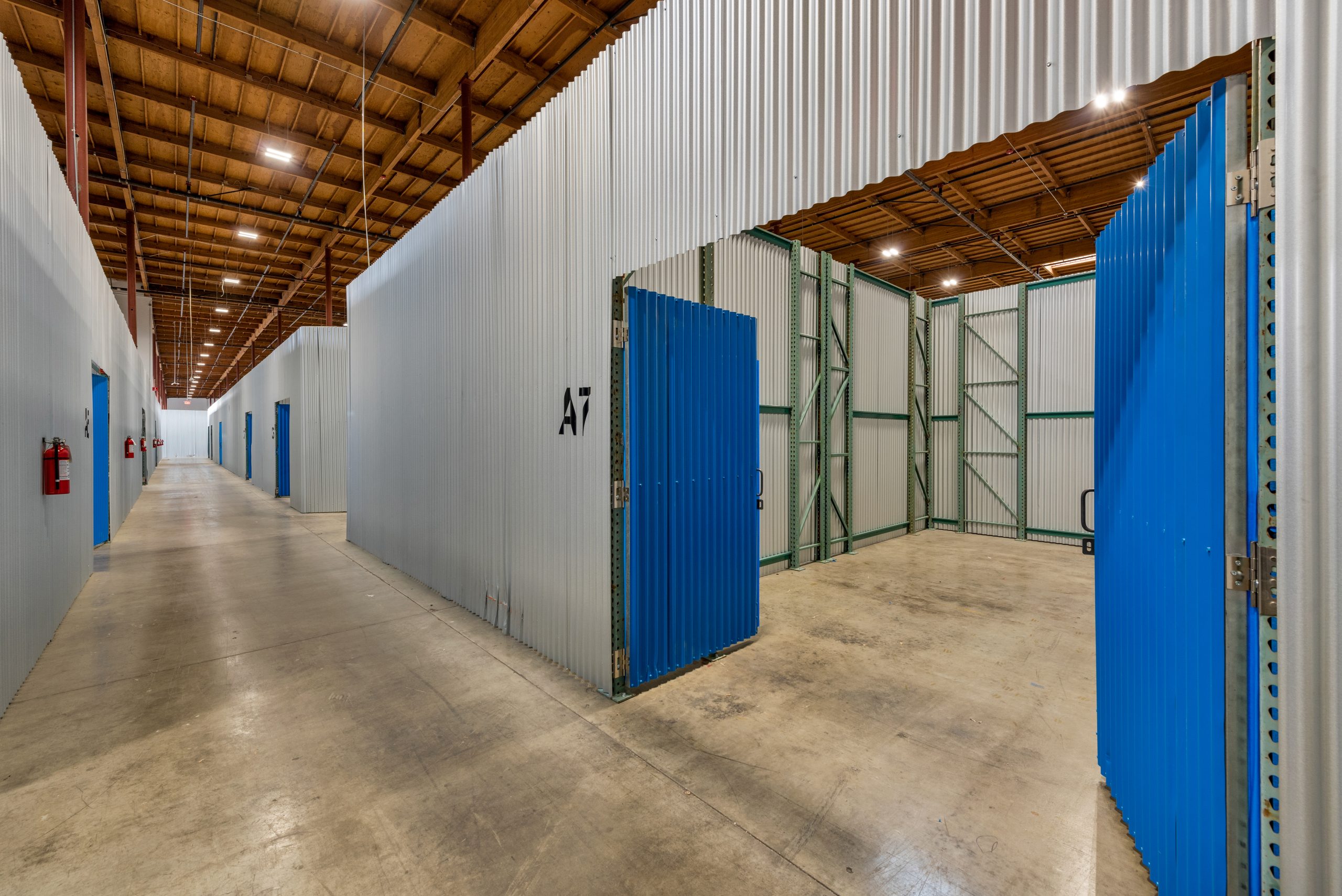
Atlanta’s co-warehousing and flexible warehouse market is still emerging compared to more established markets like Miami or Los Angeles, but the structural conditions favor growth. The same undersupply dynamic driving small-bay outperformance across the metro applies even more acutely to the sub-5,000 SF segment where co-warehousing operators typically compete.
Who’s leasing flexible space in Atlanta: E-commerce operators needing fulfillment space near Georgia’s population center, contractors requiring tool and materials storage, film production companies needing staging and prop storage (Atlanta is now the largest film production market outside of LA), and small manufacturers serving the Southeast.
The structural advantage: No developer is building speculative small-bay co-warehousing. Every unit in this segment is either a conversion of existing multi-tenant industrial or a purpose-built operator facility. Atlanta’s continued population growth — the metro has added 500,000+ residents in the past 13 years — keeps demand-supply dynamics favorable for flexible space operators.
You can browse available small-bay and co-warehousing listings in Atlanta on WareCRE’s marketplace.
Looking for warehouse space in Atlanta?
Key Trends to Watch
1. Absorption Surge Signals Market Turn
Q1 2026 absorption of 4.1–5.2 million SF was more than five times the Q1 2025 total. I-85 North drove the bulk of it, but every major submarket posted positive numbers — including Airport/South Atlanta, which had been a persistent drag through 2025. If this pace holds through Q2, expect vacancy to begin compressing in the back half of the year.
2. Tariff-Driven Inventory Front-Loading
With effective tariff rates at levels not seen in a century, businesses across Atlanta’s distribution corridors are pulling inventory forward — securing space to stockpile goods before potential rate increases. This is creating near-term absorption pressure, particularly for 10,000–50,000 SF mid-bay distribution space. The risk: if trade policy stabilizes, the pre-buy wave could leave excess inventory and a demand air pocket in late 2026. For a deeper look, read How Tariffs Are Reshaping Warehouse Demand in 2026.
3. Small-Bay Structural Undersupply
The national trend holds in Atlanta: small-bay industrial vacancy is structurally tighter than big-box. Very little new small-bay supply has been built in the last decade, while demand from SMBs, e-commerce, contractors, and last-mile operators grows steadily. Infill and smaller-format assets near population centers are outperforming large logistics buildings in every metric — vacancy, rent growth, and lease-up velocity. This is the segment where rent growth has the most room to run. See our analysis: Small-Bay vs. Big-Box: What the Vacancy Gap Means.
4. Port of Savannah Tailwind
The Port of Savannah — the fastest-growing container port in the US — continues to drive inland distribution demand in Atlanta. As Savannah handles larger vessel volumes post-Panama Canal expansion, cargo increasingly moves by rail and truck to Atlanta for Southeast distribution. This structural tailwind supports long-term absorption independent of any single occupier or industry.
Outlook: What to Watch in Q2–Q3 2026
Atlanta’s industrial market is stabilizing, not softening. The fundamentals that made it the Southeast’s dominant distribution hub — central geography reaching 80% of the US population within a two-hour flight, Hartsfield-Jackson’s cargo operations, three intersecting interstates, and a deep logistics workforce — haven’t changed. What’s changed is that supply has caught up with demand after a historic construction cycle, and now absorption is responding.
Expect vacancy to plateau in the 8–9% range through mid-2026, then begin tightening as deliveries slow and absorption sustains. The five-year average is 7.1% — the market is working its way back.
Rents will stay flat to modestly positive for big-box distribution. Small-bay and flex rents will continue growing as structural undersupply persists. The premium corridors (I-85 North, GA-400) are already tightening.
The best-positioned operators are those with well-located small-bay and multi-tenant product in infill corridors — Fulton Industrial, the I-85 corridor through Gwinnett, and the Airport/South submarket where the correction is creating value opportunities that won’t last.
The biggest risk is the reaccelerating construction pipeline. At 14.3 million SF underway, Atlanta risks another supply wave if absorption doesn’t sustain the Q1 pace. Lending discipline and pre-leasing requirements are tighter this cycle, but developers have short memories. The secondary risk is tariff policy whiplash — if the front-loading demand reverses, Atlanta’s distribution-heavy market would feel it.
Find warehouse space in Atlanta
Browse co-warehousing, small-bay, and flex listings across metro Atlanta.
Data sources: Cresa Atlanta Q1 2026 Industrial Market Report, CBRE Atlanta Industrial Figures Q1 2026, Matthews Atlanta Industrial Market Report Q1 2026, Partners Real Estate Atlanta Q1 2026, Avison Young Atlanta Industrial Market Report, Savills Atlanta Q1 2026, Cushman & Wakefield Atlanta MarketBeat Q1 2026, WareCRE marketplace data (May 2026).
Related Resources
Frequently Asked Questions
What is the current industrial vacancy rate in Atlanta?
Atlanta’s overall industrial vacancy sits at approximately 8.3–8.7% as of Q1 2026, roughly stable year-over-year and trending toward improvement as absorption surges. The range reflects different methodological approaches across brokerages. Vacancy varies significantly by submarket — I-85 North runs below 7% while Airport/South Atlanta is at 10.6%.
How much does warehouse space cost in Atlanta?
Average asking rents in metro Atlanta are $9.93/SF NNN as of Q1 2026, up 2.2% year-over-year. Rates range from $6.50–8.50/SF in value submarkets like Airport/South Atlanta and I-20 West, to $10–12/SF in the premium I-85 North corridor, up to $14.75/SF in the supply-constrained GA-400/North submarket.
What are the best areas for warehouse space in Atlanta?
I-85 North (Gwinnett to Jackson County) is the metro’s top-performing corridor with the lowest vacancy and strongest absorption. For value, Airport/South Atlanta offers rates 30–40% below the I-85 corridor with Hartsfield-Jackson proximity. I-20 West and the Fulton Industrial corridor deliver city access at moderate rents. Your best submarket depends on whether you prioritize logistics infrastructure, labor access, or cost.
Is now a good time to lease warehouse space in Atlanta?
For big-box tenants (20,000+ SF), yes — vacancy is above the five-year average and landlords are offering concessions in secondary locations. Airport/South Atlanta’s correction creates particularly strong opportunities at $6.50–8.50/SF. For small-bay tenants (under 10,000 SF), inventory remains tight in infill locations. In both cases, the construction pipeline is reaccelerating, so today’s conditions may not persist into 2027.